The Pillars of Existence: An Introduction to the Kabbalistic Tree of Life
To encounter the Kabbalistic Tree of Life (Etz Chaim) is to confront one of the most potent and intricate metaphysical diagrams ever conceived by the human spirit. It is not merely a symbol but a living cartography of the cosmos, the soul, and the divine bridge between them. Rooted in the secret wisdom of Judaism, its purpose is nothing less than to chart the descent of the Infinite into the finite and to provide the path for the human soul’s audacious ascent back to its source. This is not a philosophy for passive contemplation but a dynamic system for active transformation—a blueprint for Tikkun Olam, the repair of a fractured world.
The Architecture of Emanation: The Ten Sefirot
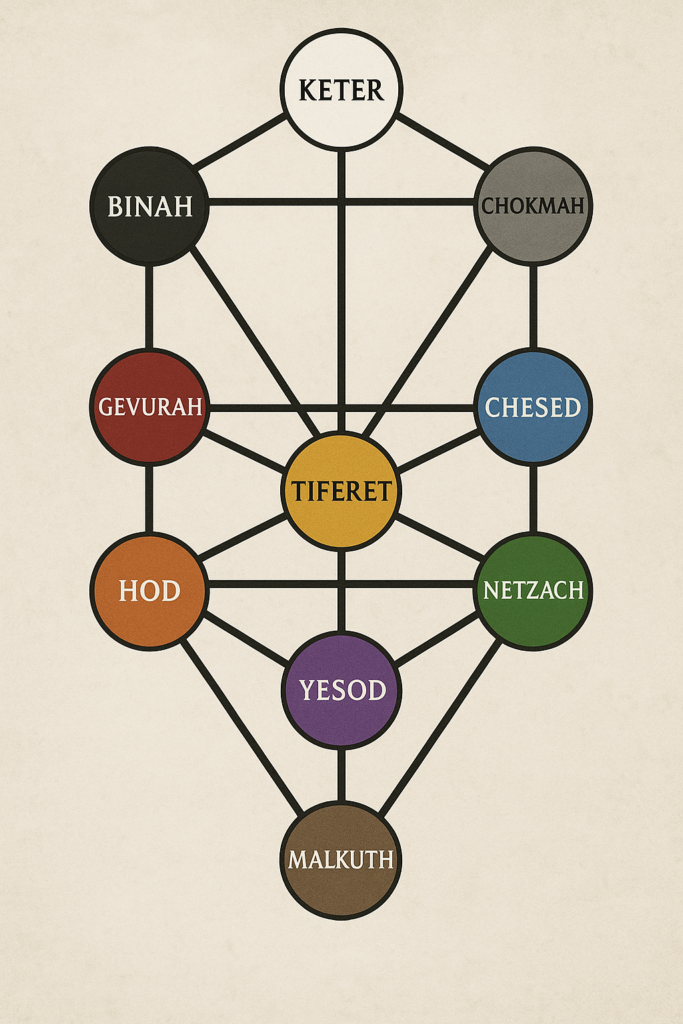
The Tree consists of ten emanations, or Sefirot, through which the unknowable, limitless Divine (the Ein Sof, “Without End”) progressively reveals Itself and creates the universe. These are not gods but divine attributes, vessels, or modes of consciousness. They are arranged in a precise hierarchical structure along three pillars:
- The Central Pillar (Pillar of Equilibrium): The spine of the Tree, representing perfect balance and the direct channel of divine will. It holds Keter (Crown), Tiferet (Beauty), Yesod (Foundation), and Malkhut (Kingdom).
- The Right Pillar (Pillar of Mercy): The active, expansive, masculine force. It holds Chokhmah (Wisdom) and Chesed (Loving-kindness).
- The Left Pillar (Pillar of Severity): The restrictive, formative, feminine force. It holds Binah (Understanding) and Gevurah (Judgment/Strength).
This triadic structure reflects a fundamental cosmic law: reality emerges from the dynamic tension and reconciliation of opposing forces—expansion and contraction, giving and withholding, grace and judgment.
From the apex to the material world, the ten Sefirot are:
Keter (The Crown):
The primal will, the ineffable spark of the Ein Sof. It is not a “thing” but the first point of becoming.
Chokhmah (Wisdom):
The flash of pure insight, the seminal “father” energy. Undifferentiated potential.
Binah (Understanding):
The nurturing “mother” who receives the seed of Chokhmah and gives it form, depth, and structure. The womb of analysis.
Chesed (Loving-kindness):
Unbounded grace, benevolence, and the urge to create and give without limit.
Gevurah (Strength/Judgment):
The necessary force of limitation, discipline, and boundary. Without it, Chesed’s love would flood and destroy all form.
Tiferet (Beauty/Compassion):
The heart of the Tree and of reality. It harmonizes the boundless love of Chesed and the stern judgment of Gevurah into compassionate truth.
Netzach (Eternity/Victory):
The enduring drive of instinct, emotion, and the artistic impulse.
Hod (Splendor/Glory):
The intellect, logic, and communicative power. The tension between Netzach (feeling) and Hod (thought) mirrors that of Chesed and Gevurah.
Yesod (Foundation):
The vital channel that gathers and concentrates all the energies from the Sefirot above. It is the psychic and archetypal realm, the “filter” into our world.
Malkhut (The Kingdom):
The physical world of manifestation, the Divine Presence (Shekhinah) in exile. It is both the recipient of all the light from above and the starting point for the human journey upward.
These Sefirot are connected by 22 Paths, corresponding to the 22 letters of the Hebrew alphabet, which are the “substance” of creation.
The Human as Microcosm: The Inner Tree
The Tree’s supreme wisdom lies in its correspondence. The macrocosm is the microcosm. The divine structure of the universe is mirrored perfectly in the architecture of the human soul. Each Sefirah relates to a specific facet of our psychology and spiritual experience:
- Chesed is our capacity for unconditional love; Gevurah is our necessary self-discipline.
- Tiferet is our authentic heart-center, where we integrate our contradictions.
- Malkhut is our physical body and grounded presence in the world.
Thus, psychological imbalance or existential suffering can be understood as a blockage or imbalance in the flow of energy between specific Sefirot within one’s personal Tree. Neurosis might be an overactive Gevurah (harsh self-judgment) strangling Chesed (self-love). A lack of direction often signals a disconnect from Chokhmah (intuitive wisdom).
The Path of Return: Tikkun and Ascent
The Tree is not a static map but a guide for the soul’s ascent. This is the work of the mystic or the serious seeker: to consciously reverse the flow of creation. One begins in Malkhut, in the midst of embodied, often fragmented life, and through meditation, ethical action (mitzvot), focused prayer, and deep study, one “climbs” the paths.
This climb is an alchemical process of integration. To move from Yesod to Tiferet, for instance, is to transmute basic drives into compassionate heart-centered action. Each step involves balancing the pillars within oneself—mercy with severity, inspiration with intellect. The ultimate goal is Yichud (Unification): to heal the perceived separation between the Shekhinah (in Malkhut) and the Holy One, Blessed be He (in Tiferet and above), and thus to sense the unity of all being within the Ein Sof.
A Word on Sources and Transmission
This system did not spring forth fully formed. Its seminal text is the Zohar (The Book of Splendor), a mystical commentary on the Torah revealed in 13th-century Spain and attributed to the 2nd-century sage Rabbi Shimon bar Yochai. Its concepts were systemized in the 16th century by the giants of Safed Kabbalah, most profoundly by Rabbi Isaac Luria (the Ari). Lurianic Kabbalah, with its doctrines of Tzimtzum (Divine Contraction), the “Shattering of the Vessels,” and Tikkun, provides the dominant framework for understanding the Tree’s dynamic purpose.
To study the Tree of Life is to engage in a centuries-old chain of transmitted wisdom. It demands rigor, reverence, and a prepared consciousness. As the Zohar itself warns, these are not matters to be approached lightly, for they deal with the very roots of one’s soul and the structure of reality. It is a path for those who seek not just information, but transformation—who dare to see the universe as a divine utterance and themselves as a crucial letter within its sacred text. The Tree stands as an eternal invitation: know the map, walk the paths, and participate in the healing of the world.
Kaplan, Aryeh. Inner Space: Introduction to Kabbalah, Meditation and Prophecy. Moznaim Publishing, 1990. : Kabbalah Tree of Life A Beginner’s Introduction — A Beginner’s Introduction Dennis, Geoffrey. The Encyclopedia of Jewish Myth, Magic and Mysticism. Llewellyn Publications, 2007. : Kabbalah Tree of Life A Beginner’s Introduction — A Beginner’s Introduction
Comments